
How to Check for a Warrant in Auburn
Auburn publishes no city-only warrant database. So a practical Auburn warrant search runs through the Sheriff's official link, the state court case system, and a direct call to confirm. Give your full identifying details. A loose name match proves nothing.
- Begin at the DeKalb Sheriff warrant page and read its currentness warning before following the linked search.
- Search MyCase for a DeKalb case, using a cause or citation number when one is known.
- Call the Clerk criminal line at 260-925-4575, or traffic line at 260-925-4576, to ask which court controls the docket.
- Call the Sheriff at 260-925-3365 for current service, custody, bond, or surrender instructions.
- Ask the issuing court whether the warrant remains active and whether an appearance, attorney filing, hearing, or surrender is required.
Indiana offers no public statewide arrest-warrant search. MyCase searches cases, so an Auburn warrant shows up there only when it is public and tied to a visible case.
Auburn's Two-Address Warrant Route
Auburn is the county seat, and its main offices sit close together but not under one roof. The DeKalb Circuit Court, the Superior Courts, and the Clerk all work out of 100 S. Main Street. The Sheriff and the jail sit at 215 E. 8th Street. That split mirrors the jobs. Courts issue, recall, and record warrants; the Sheriff serves them, books people, and explains surrender logistics. Auburn Police is at 210 S. Cedar Street, first floor of City Hall, and its desk can help identify an incident or report. It cannot recall a county-court warrant on its own. Figure out first whether your question is about the city incident, the court docket, or custody, because Auburn's county-seat role makes the route concrete: a police report at City Hall, the cause number from the Clerk at the courthouse, then service or surrender details from the Sheriff at the jail. Proximity does not merge those records, so ask each office only for the part it controls and carry the same cause number from one contact to the next.
The official 2020 population of 13,412 describes Auburn's size, nothing more. It does not mean Auburn holds more warrants than another DeKalb community, and no official city-by-city warrant count exists to settle the question. Auburn also gives the clearest route for a narrow Sheriff records request. The official form asks for the date, time, location, incident number, people involved, and a clear description of the record you want, and those fields help the Records Division find an existing document. They will not turn a request into a live warrant check, force release of confidential material, or prove a court order is still active. Pair any released record with the latest docket and direct Sheriff confirmation, and keep the request aimed at a known event or case rather than an undefined database.
Quick route: police report questions go to Auburn Police; case-status questions go to the Clerk or court; service and surrender questions go to the Sheriff.
The Auburn Police Department and Municipal Court
Auburn has no separately documented city court the way Butler does. Auburn Police investigates city matters and can make arrests, but DeKalb Circuit Court, Superior Court I, or Superior Court II keeps the court record under local assignment rules. The cause number and court code, not city residence, point to the right docket.
Auburn Police Department
210 S. Cedar Street, first floor of City Hall, Auburn, Indiana. The official Auburn Police page lists 260-920-3200 and police@ci.auburn.in.us.
DeKalb County Clerk of Courts
100 S. Main Street, Auburn, Indiana. Use 260-925-4575 for criminal matters or 260-925-4576 for traffic matters.
The Clerk can identify the court record. Auburn Police can explain its own report, though a report alone neither proves a warrant issued nor confirms one is still active.
Auburn Police Fees Are Not Warrant Fees
The Auburn Police page posts its service fees: $10 for a crash report, $6 for an incident report, $5 for a VIN check, and $0.50 for a bike license. Those are police-service charges, and none is described as a warrant-clearance cost, a court payment, or a bond amount. Buying a report changes nothing about an Auburn warrant. If a court record shows bail, the warrant or the judge's order controls it. DeKalb's posted schedule is advisory for arrests without a warrant, so do not use it to predict what a judge will require in a specific Auburn case. Ask the court and the Sheriff for the current amount and the accepted payment method. Note: A report receipt proves only that the report service was paid, not that any warrant was recalled.
Types of Auburn Warrants
Several Auburn documents carry the word warrant for different purposes. The issuing authority, cause number, and order text tell you more than any broad label.
| Type | How it arises | Who controls it |
|---|---|---|
| Arrest warrant | Probable cause or an information supports an arrest command | DeKalb judge and issuing court |
| Bench warrant | A required appearance or release condition was missed | Judge handling the case |
| Traffic FTA warrant | A qualifying traffic complaint or appearance was not answered | Assigned court, often Superior Court I for moving traffic |
| Search warrant | Police seek authority to search for evidence | Judge; usually Superior Court I under local rule |
| Tax warrant | Indiana seeks collection of a tax debt | Indiana Department of Revenue process |
A search warrant is not an arrest command, and an Auburn tax warrant is not a criminal wanted notice.
Verifying an Auburn Court Number
A DeKalb cause number opens with the county code and a court identifier. The Odyssey list names Circuit Court 17C01, Superior Court I 17D01, and Superior Court II 17D02. A sample like 17D01-CR-000123 shows the parts but is not a real Auburn case.
- 17C01
- DeKalb Circuit Court identifier.
- 17D01
- DeKalb Superior Court I identifier.
- 17D02
- DeKalb Superior Court II identifier.
- FTA
- Failure to appear, a docket event that may lead to a bench warrant.
Read the cause number from the court record itself. Repeat it when you call. In Auburn, a name alone can collide with another person, while the court identifier sends your question to the correct docket.
What an Auburn Warrant Record Shows
Indiana Code 35-33-2-2 sets the baseline for an arrest warrant. An Auburn public docket may add later events that matter greatly to current status.
| Cause number | The DeKalb court identifier and case sequence, such as 17C01-CR-000123. |
|---|---|
| Name or description | The person identified by the warrant; verify carefully with the office. |
| Offense | The alleged charge or nature of the offense, not a conviction. |
| Issue details | Date, county, issuing judge or clerk, and command to arrest. |
| Bail | The amount endorsed by the court, if any. |
| Status events | Service, return, recall, quash, hearing, or later disposition. |
A stale vendor result can mislead. The newest docket entry can change what an older Auburn search seems to say, so confirm any recall with the court and ask the Sheriff whether its service record was updated.
Auburn Traffic Warrant Checks
Start with the Auburn citation or cause number. Then call the Clerk traffic line at 260-925-4576. Indiana Code 9-30-3-8 lets a court issue a warrant after certain failures to appear or answer. That statute can also bring the Bureau of Motor Vehicles into play once a warrant has gone unexecuted for 30 days. Payment and recall are separate docket events. Paying an online balance does not always recall the Auburn warrant by itself, so confirm with the clerk. Ask whether the warrant was recalled, whether a hearing remains, whether the BMV was notified, and what written receipt or order proves the current result. The traffic warrant court guide explains that split. Write the answer down. Note: Never give a driver’s license number, full birth date, or private address when someone helps you locate an Auburn case.
Where Auburn Warrants Fit With DeKalb County
Auburn police may investigate an event, but the DeKalb court that signs a warrant controls its judicial status. The Sheriff then handles service, custody, booking, and surrender. Indiana’s restricted IDACS system carries justice data, yet it stays closed to the public.
Warrant flow: Auburn Police › DeKalb Circuit or Superior Court › DeKalb County Sheriff › restricted state and national justice systems
Cases can start outside Auburn. Auburn residence does not pick the issuing court. The flow between city and county is rarely linear, and a case can begin anywhere. For the broader court map and other county channels, use the DeKalb County warrant records overview.
Auburn Bail Questions at the Jail
The county jail lobby is open around the clock. The Sheriff’s bail and bonds page describes cash, clerk, surety, and own-recognizance release. A judge sets bail. A payment option alone does not promise release in a particular Auburn case.
- Ask for the exact warrant and cause number.
- Confirm whether a judge set bail or requires a hearing.
- Ask which bond form is accepted for that order.
- Confirm fees and payment instructions directly.
- Keep a receipt and later verify the docket.
Three options stand out. The Sheriff warrant page suggests consulting an attorney, turning yourself in, or contacting the issuing court. Before a voluntary Auburn surrender, ask about identification, medication, transportation, booking, bond, and the next hearing.
Public Access to Auburn Warrant Records
Auburn records do not live in one place. Police reports sit with the police department. Case filings and orders stay with the Clerk and court, while the Sheriff may hold service, booking, or related agency records. A narrow, specific request works far better than a demand for some vague warrant database.
Key rules:
Indiana Access to Public Records Act, IC 5-14-3 provides access to existing public agency records, subject to exceptions and reasonable agency procedures.
Indiana Administrative Rule 4 starts with public access to court records, subject to exclusions.
Indiana Administrative Rule 5 protects confidential categories and information made private by law or court order.
Remote access can be narrower than courthouse access. Not everything gets released. Search-warrant applications, juvenile matters, protected identifiers, and sealed material may be withheld or redacted, and an APRA request never forces an Auburn agency to create a new record or certify that a vendor list is complete.
Auburn Warrant Scam Prevention
In March 2025, the DeKalb Sheriff warned Auburn residents about phone scammers. Callers posed as law-enforcement officers and claimed people had warrants tied to missed jury duty. The Sheriff said its personnel never call to discuss outstanding warrants or fines needing collection. Caller ID is not a safe check.
- End the call without sharing personal or payment information.
- Find the Sheriff, police, Clerk, or court number on an official site.
- Call 260-925-3365 for the Sheriff or the relevant Clerk line.
- Ask for the cause number, issuing court, and current docket status.
- Report a scam attempt through an appropriate official channel.
Gift cards clear nothing. No legitimate Auburn warrant is settled through gift cards, cryptocurrency, a wire transfer to a caller, or a remote “release fee.”
Auburn Warrant Office Reference
The official Auburn Police page posts the city contact for records and incident questions.
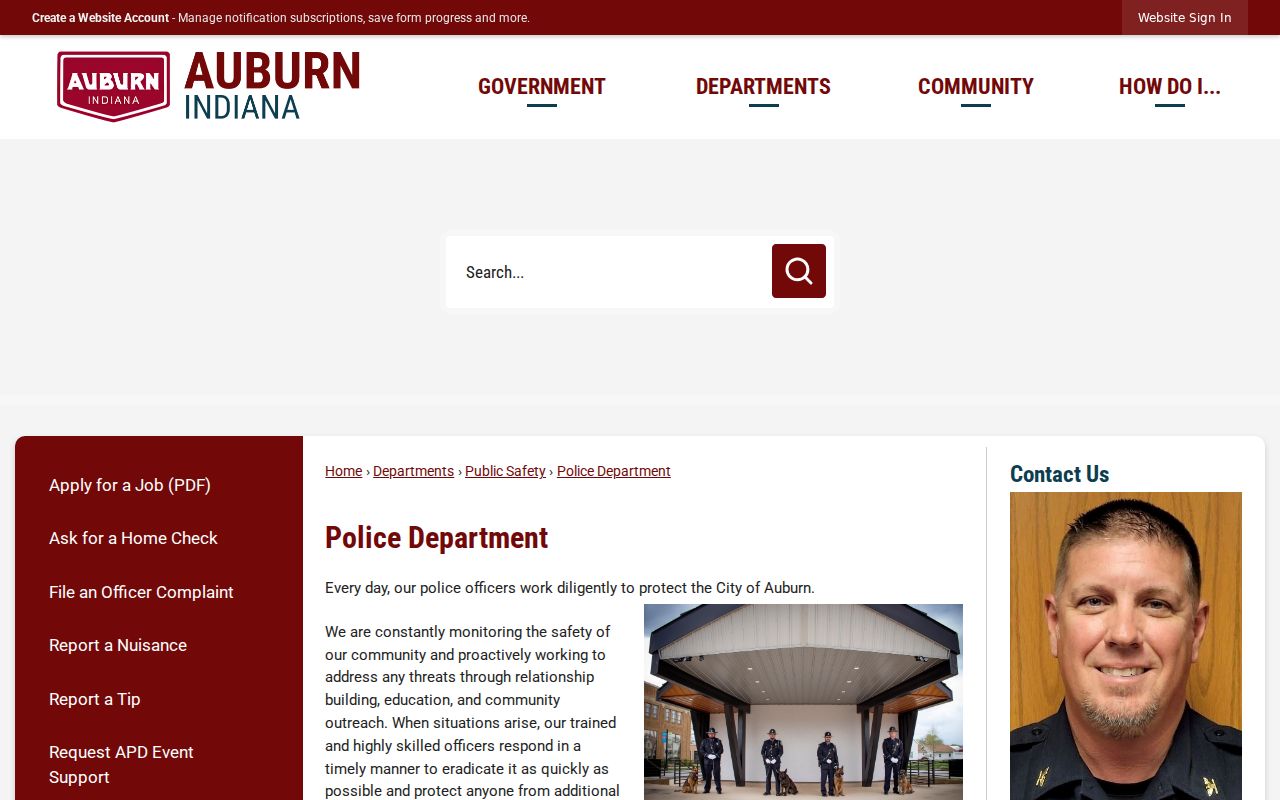
That page finds the city office. For current warrant status, an Auburn caller still needs the issuing court or Sheriff.